
WELCOME TO THE
RESEARCH
Dr. Wenyi Li is a Senior Lecturer and NHMRC Investigator (Emerging Leadership Level 1) in the development of antimicrobials to combat nosocomial infections by using his chemical biology expertise and skillset at the Department of Biochemistry, La Trobe Institute for Molecular Science, La Trobe University, Melbourne, Australia. By fostering an active collaborative research network, Dr Li has obtained several outstanding successful grants of a total of >$2 million, including 1 NHMRC Investigator EL1 grant, CIA Ramaciotti Health Investment Grant and 1 CIE NHMRC Ideas Grant. In recognition of the young scientist's excellent contribution to peptide sciences, Dr Li recently received the most prestigious Rennie Memorial Medal from the Royal Australia Chemical Institute (RACI, 2024), Young Investigator Award (Pharmaceuticals, 2025) and a Young Peptide Scientist Award from the Chinese Peptide Society (2023). Dr Li has served as an expert reviewer for several funding systems, such as ARC, NHMRC and HFSP, and as the associate editor of the International Journal of Antimicrobial Agents. In addition to his research, Wenyi is currently serving as the President-Elect of the Victorian Branch of RACI.Fostering innovation through cutting-edge research
Current Research
Latest Publication
Research

News
News
“One quote that I find particularly inspiring comes from the renowned physicist Enrico Fermi: 'There are two possible outcomes: if the result confirms the hypothesis, then you've made a measurement. If the result is contrary to the hypothesis, then you've made a discovery.' For me, this quote deeply highlights the value of both validation and unexpected findings in research, reminding me that progress is made not only through success but also by the unknown/failure.”
— Dr. Wenyi Li
Contact
Address
La Trobe Institute for Molecular Science
Department of Biochemistry and Chemistry
La Trobe University | Bundoora, Victoria | 3086 | Australia
Email
wenyi.li@latrobe.edu.au
Phone
+61 (03) 9479 6336
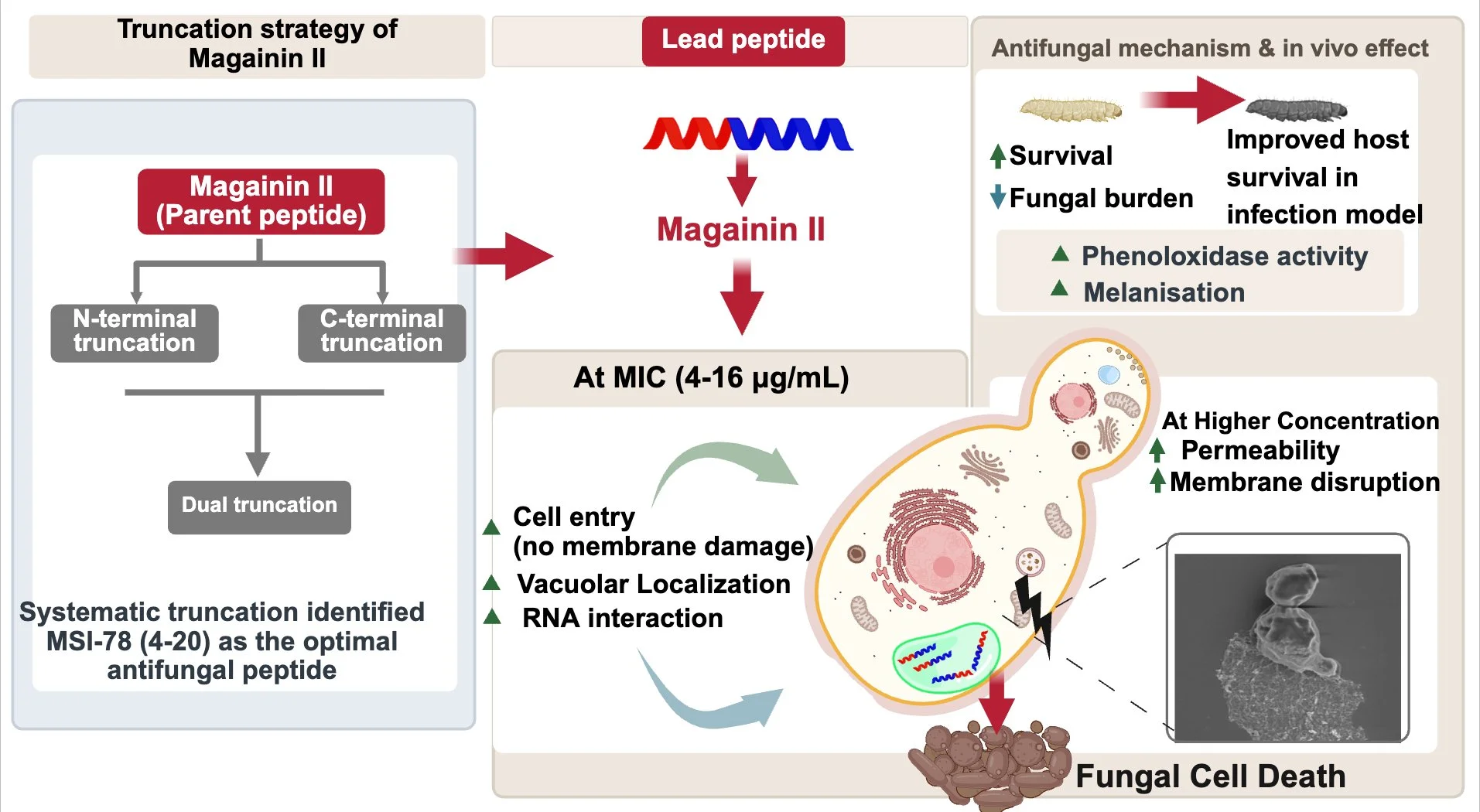
The increasing antifungal resistance, including Candida albicans resistance, highlights the urgent need for novel antifungal agents. Antimicrobial peptides are promising alternative antimicrobial agents, but most work focuses on antibacterial studies, including Magainin II and its derivative Pexiganan (MSI-78). Here, we evaluated a Pexiganan peptide library and identified MSI-78 (4–20) as a lead-hit antifungal agent against multiple Candida species, including fluconazole-resistant C. auris isolates. Importantly, it improved survival and reduced fungal burden in C. albicans-infected Galleria mellonella, suppressing phenoloxidase activity and melanization. Mechanistically, it entered cells at 16 μg/mL with limited membrane damage, whereas 32 μg/mL caused membrane disruption and intracellular leakage. Transcriptomics revealed activation of stress-response and cell-surface remodeling, with repression of carbon metabolism and respiration. These findings indicate a concentration-dependent mixed mode of action combining metabolic stress at lower exposure and membrane disruption at higher concentrations. MSI-78 (4–20) therefore represents a magainin-derived scaffold for antifungal development.